Lakeville Wood Flooring quotes wood flooring in South St. Paul against a deadline the city itself sets, because a floor an evaluator marks hazardous has to be corrected before a buyer can take possession. That is a different starting point from a color or a sheen. It makes the floor a scheduling problem with a second party attached, and it is why most of the calls that reach us here arrive with a date already on them.
A wood floor that has cupped, buckled or lifted at the fasteners stops being a cosmetic complaint once a sale is underway, because somebody is about to write down what condition it is in. Our first visit is a measurement visit rather than a sales call, and more than twenty years in the trade is why: the useful answer to what a floor needs is a number and not an opinion.
We take a relative humidity reading on that first visit and write it on the quote, with the 30 to 50 percent band wood flooring is specified for printed beside it. We measure the moisture content of the flooring and of the subfloor against each other and record both numbers before the first board goes down. What that gives an owner, a seller or a buyer is a scope that survives a second look.
The evaluation report comes before the showing
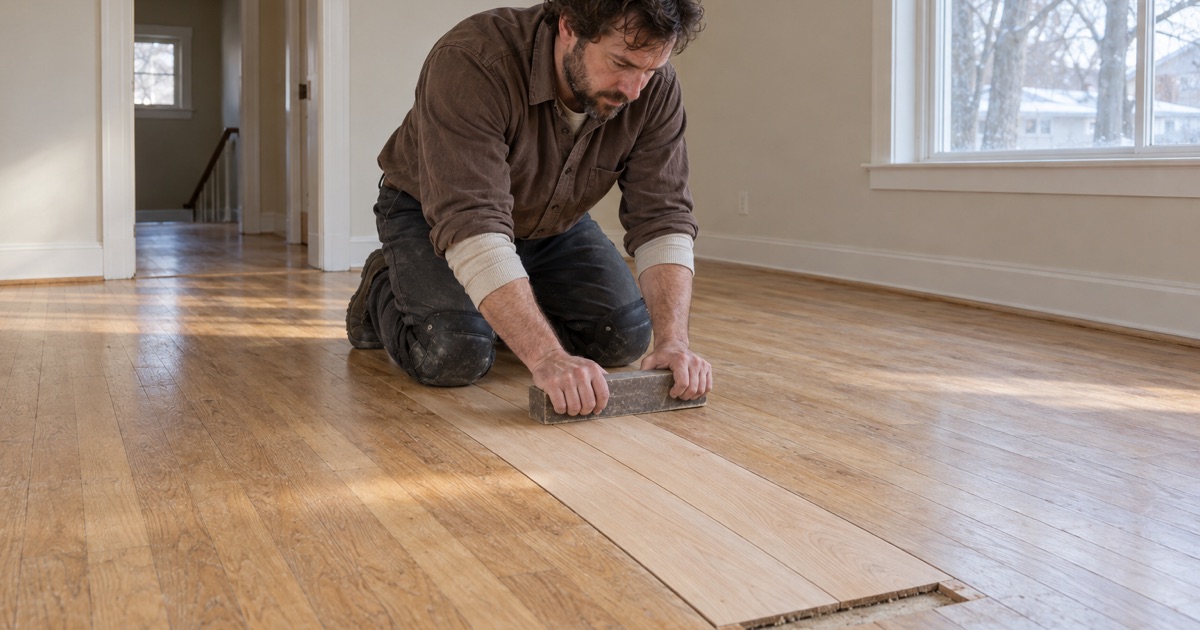
The City of South St. Paul runs a Time-of-Sale Housing Inspection Program, and the requirement sits in City Code Chapter 106, Article VI, at sections 106-178 through 106-185. A homeowner has to have the evaluation report available when the property is shown, and the program reaches single-family, two-family and multiple-family dwellings alike.
The evaluation is performed by a housing evaluator the city licenses, which is a third party rather than the contractor a seller hires to do the repairs. Inspection costs are set by individual evaluators rather than by the city, so the fee is not a published municipal number. We do not perform these evaluations and we do not issue reports, and our work starts where a floor turns out to be one of the items on one.
Three findings, not two
The report does not simply come back as a pass or a fail. It states whether the dwelling meets city requirements, is below them, or is hazardous, and those three findings carry very different consequences. The evaluator gives the original to the seller and files a duplicate with the city within ten calendar days, so the finding exists on record somewhere other than the seller’s kitchen table.
The third category is the one that reorganizes a schedule. An item marked hazardous is not a note for the buyer to weigh against the asking price; it has to be corrected, and we build the scope around that from the first visit.
Why the finding tends to land on floors here
There are 8,639 housing units in the city, and 77.1 percent of them predate 1980. The 1950s is the largest single build cohort at 24.4 percent, with pre-1940 construction second at 22.6 percent, and only 12.2 percent of units were built in 2000 or later.
The city was incorporated March 2, 1887 and grew around the stockyards, whose two largest employers at peak were Swift and Company and Armour Meats, and those stockyards closed around 2008. Floors in a stock of that age have usually been sanded before, sometimes more than once, and how much board is left above the tongue is the first thing we want to know.
Owner-occupied units are 69.7 percent of occupied housing, so most transfers here involve an owner selling a house they have lived in. The floor being evaluated is a floor somebody has been walking on for years, which means its problems are rarely sudden.
Looking for wood-flooring closer to New Prague? See New Prague Wood-Flooring.
When a floor is the item marked hazardous
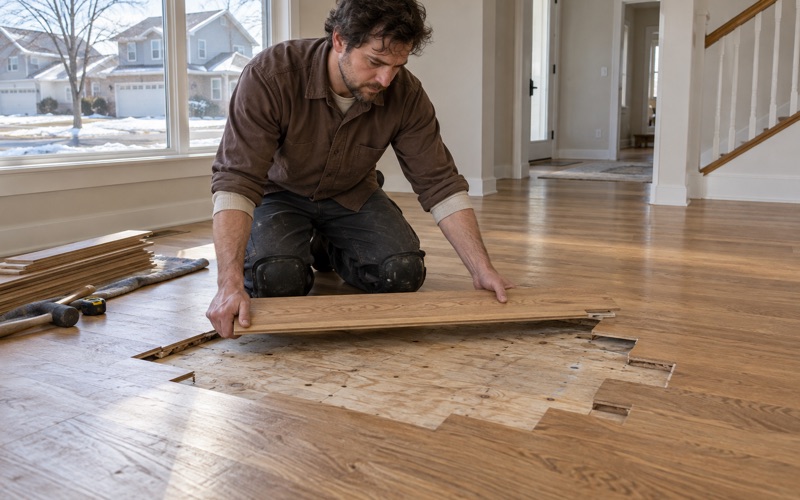
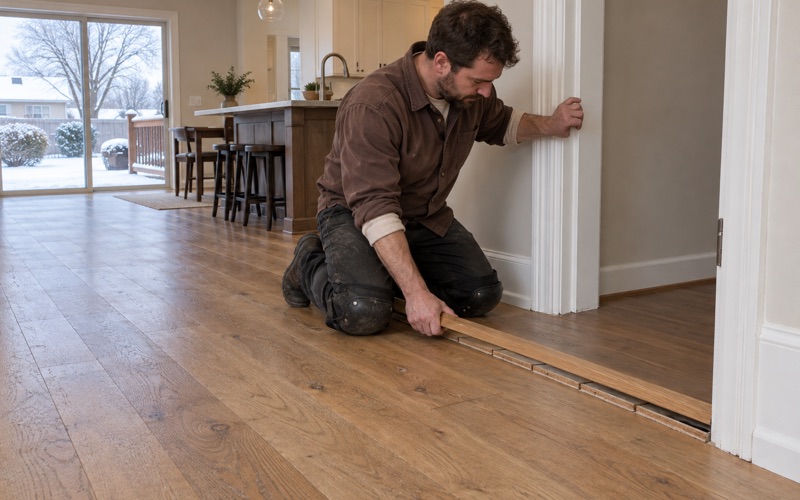
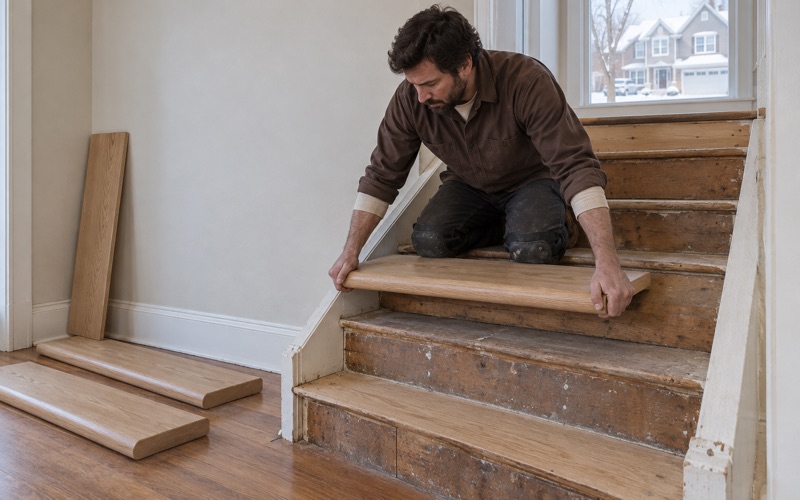
A wood floor rarely reaches a hazardous finding because of how it looks. It reaches one because a board has lifted, a fastener has let go, a plank has buckled away from the subfloor, or a stair tread has gone soft underfoot. Those are trip conditions, and they are what an evaluator is weighing when the finding stops being cosmetic.
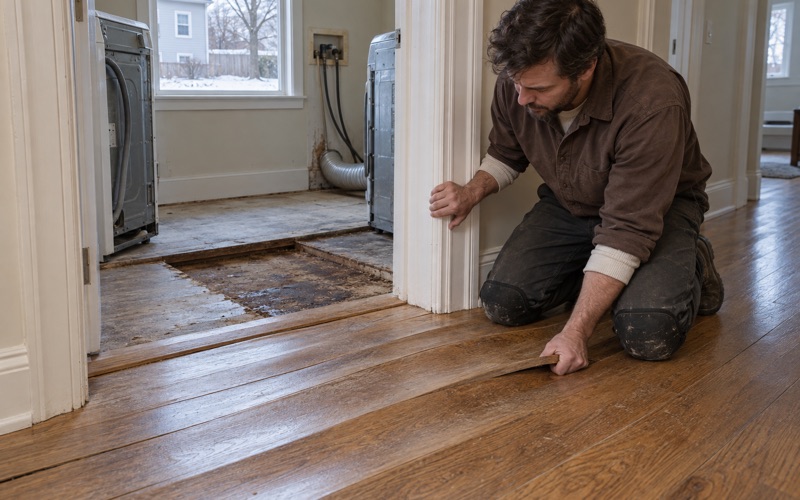
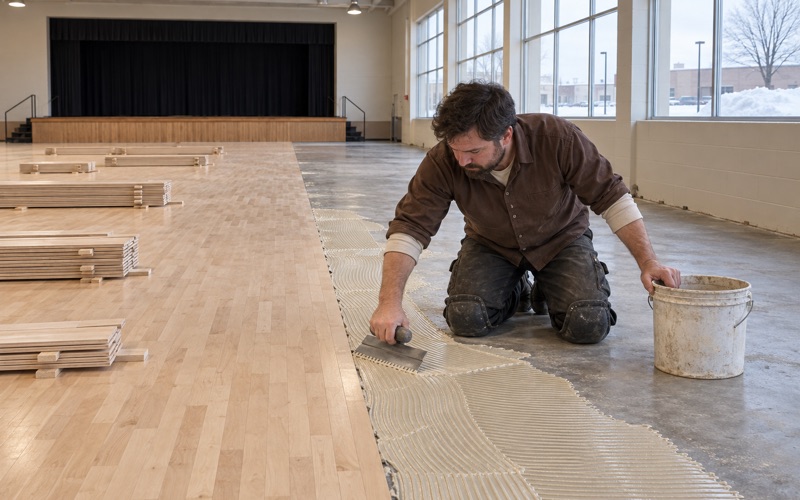
Buckling, severe cupping and hollow spots almost always trace back to moisture rather than to wear. So does the delamination that ends an engineered floor’s life, and so does the adhesion failure that lets a glued floor tick and pop under load.
What gets measured before a scope exists
We take readings with a pin meter and a pinless meter, and we read relative humidity with a hygrometer rather than estimating it from the season. The number that governs the job is the moisture content differential between the flooring and the subfloor, because a floor laid across a gap it cannot close will keep moving until something fails. Both numbers go on paper before anything is ordered.
Board width is chosen against the species’ own dimensional change coefficient, and the seasonal movement to expect at that width is stated in writing at the same time. We also explain the winter conflict before the work is booked rather than after the gaps appear, because on a deep cold snap the humidity a house can safely hold sits below the bottom of the floor’s own specification. A seller who hears that in advance is not blindsided by seasonal gapping in January.
Lower levels, grade, and the slab underneath
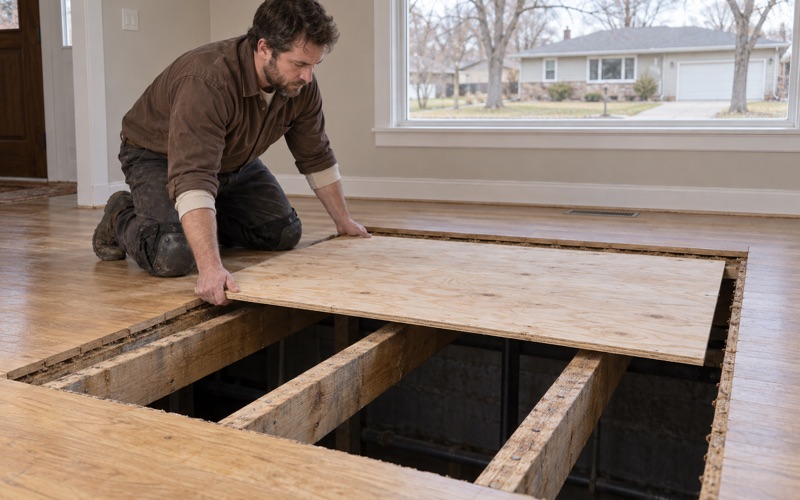
Grade is established the way the installation guidelines define it, with soil sitting within three inches of a floor putting that level below grade. A walkout or a lookout is quoted as what it is rather than as a first floor with a better view. Lower-level work is quoted from a moisture reading taken on the lower-level slab itself, never inferred from the floor above it.
Dakota County is named in Minnesota Rules 1303.1600 Zone II, where the minimum allowable footing depth due to freezing is three and one-half feet. That is a foundation rule rather than a flooring one, but it describes how much of a house here is built into ground that freezes, and lower-level slabs are where most of the moisture arguments start.
The stock is overwhelmingly detached: 5,167 owner-occupied units are one-unit detached, 88.0 percent of owner-occupied units, against 336 one-unit attached at 5.7 percent. Counted across the whole housing stock, 542 of 8,639 units sit in two-unit structures against 428 one-unit attached, so the duplex component is the larger one. In a two-unit building we plan underlayment and fastening with impact sound in mind, as a construction question rather than a paperwork one.
Thirty days, a permit, and a second evaluator
The correction window is thirty days from the report unless the building official grants an extension. The seller is responsible for correcting all hazardous conditions and for obtaining all necessary permits for that work.
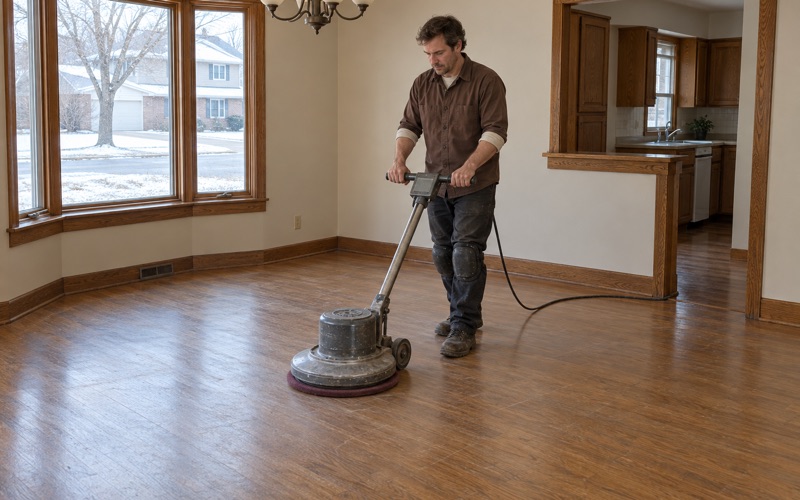
Thirty days reads as generous until a real floor schedule is laid against it. A full sand carries a written grit sequence and a finish schedule, and every coat has a cure time that will not compress because a closing date moved. We hand over the number of cuts and the number of coats with the quote, so the calendar is a commitment instead of a conversation.
The second evaluator is the point
The re-inspection cannot be signed off by the evaluator who wrote the original report, because the ordinance requires a licensed housing evaluator different from the first one. That requirement is what puts teeth in the program, and it is the part sellers most often miss.
A correction is not closed out by the person who already formed a view of the house. Somebody new walks the floor, so the repair has to read as sound to a fresh set of eyes rather than as effort expended. We scope repairs on that basis, which usually means board replacement, a weave-in or a dutchman patch that disappears into the field, not a filled trench that still looks like a filled trench.
Occupancy is the lever behind all of it. No occupancy of a vacant dwelling is permitted while a hazardous condition exists, unless the buyer signs a written acknowledgment that includes evidence of financial ability to perform the corrections. Failure by either the seller or the buyer to correct identified hazardous items is a violation of the ordinance, and so is a seller failing to disclose that an evaluation report identifies hazardous items.
Recoat or full sand, answered on the floor
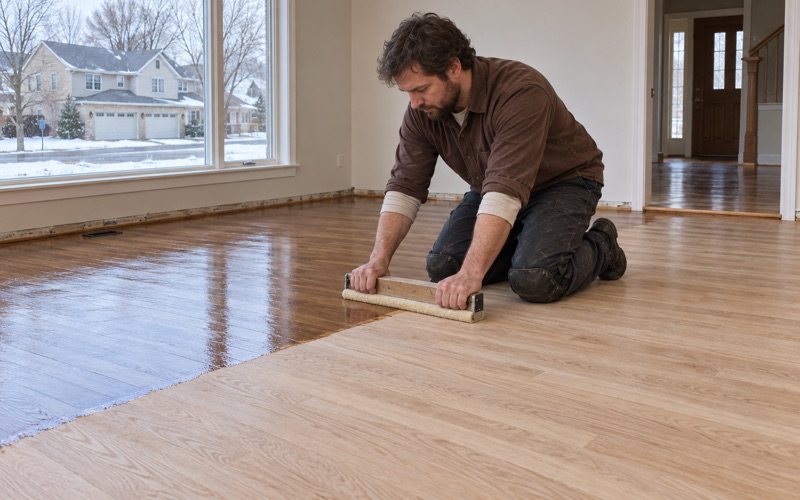
Whether a floor needs a screen-and-recoat or a full sand is not a call we make from the doorway. We answer it with a test patch on the floor, because bare wood anywhere disqualifies a recoat, and you are shown where. On an engineered floor we measure the wear layer before quoting any sanding at all, since under the sanding threshold the honest answer is replacement rather than a refinish.
Dust containment, cure times and ventilation are planned for a house that cannot open its windows for part of the year, and return-to-service times are given in writing. With a thirty-day clock running, knowing the hour a floor can take furniture again is worth as much as knowing the day it gets its last coat.
Which transfers the ordinance skips, and which it does not
Section 106-180 exempts a defined set of transfers. A newly constructed dwelling transferred to its first owner is exempt, as are transfers to a public body, transfers for demolition, sheriff’s and court-officer sales excluding a sale by a probate-court appointee, and transfers to an immediate family member for no consideration.
Everything outside that list sits inside the program, which is why a seller who assumes an ordinary sale slips past it tends to find out late. We would rather be measuring a floor in the first week of a correction window than in the third.
What a permit exemption does not do
Minnesota Rules 1300.0120 subpart 4, item A, sub-item (8) exempts painting, papering, tiling, carpeting, cabinets, countertops and similar finish work from permit. Refinishing an existing floor generally lives in that category, and structural repair of what is under it generally does not.
The same subpart states that an exemption does not authorize work performed in violation of the code or of other ordinances. No permit required is not the same sentence as no rules apply, and under a time-of-sale correction the second sentence is the one that gets tested.
Rentals and the state disclosure duty run on separate tracks
A rental housing license is required in South St. Paul, renewed annually for a June 1 to May 31 term, and it will not be issued without payment and a valid inspection on file. A landlord planning floor work around a license renewal is working to a different date than a seller inside a correction window.
Minnesota Statutes 513.55 places a disclosure duty on sellers statewide, and the city program is not a local restatement of it. A statewide disclosure duty is satisfied by telling a buyer what you know about the property, while this ordinance is satisfied only when the hazardous item has been corrected, re-inspected by a different licensed evaluator and cleared.
That difference is the whole reason our first visit is a measurement visit. When a wood floor in South St. Paul turns out to be the item on a report, the useful answer is a written scope with moisture numbers, a grit sequence, a coat count and a cure schedule attached to it. We would rather hand that over than a number that has to be revised the moment somebody looks closely.
- 20+ Years in the Trade
- Free Written Estimates
- Moisture Readings on Every Quote