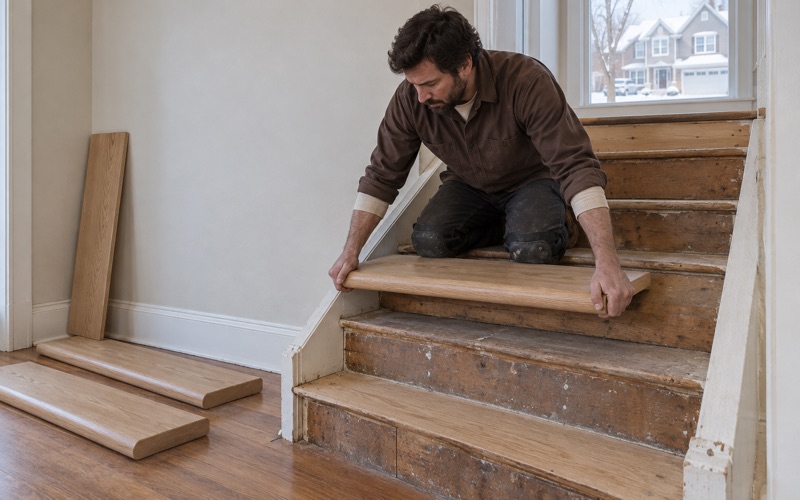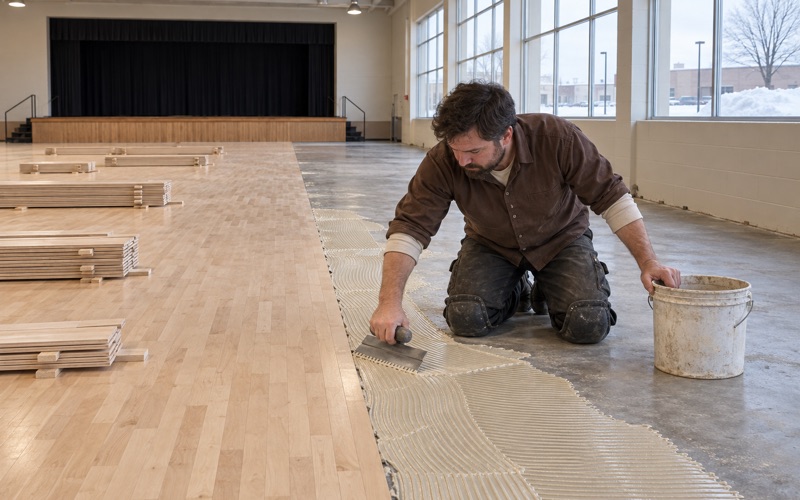
Lakeville Wood Flooring has installed, sanded and finished wood flooring in Shakopee for more than twenty years. A good share of that work sits in houses and townhomes somebody rents rather than owns, which changes the calendar far more than it changes the craft. The floor still has to be measured, acclimated and cured properly; it simply has to be all of those things by a date someone else set.
That date is usually one of two. Shakopee requires a rental license for every non-owner-occupied rental property, and the license carries a thirty-six-month term with an annual renewal inside it. Every rental unit in the city is also walked through on a three-year inspection cycle, so an owner normally knows months ahead when the property will be looked at and when the paperwork comes due.
We plan floor work backward from those dates instead of squeezing it in afterward. The first visit is a measurement visit rather than a sales call, and it ends with numbers on paper: a relative humidity reading taken in the house that day, written on the quote beside the 30 to 50 percent band wood flooring is specified for. What follows is what we actually find here, and how we sequence the work so a floor is finished, cured and walkable before the next tenant or the next inspection arrives.
A thirty-six-month license and a three-year walk-through
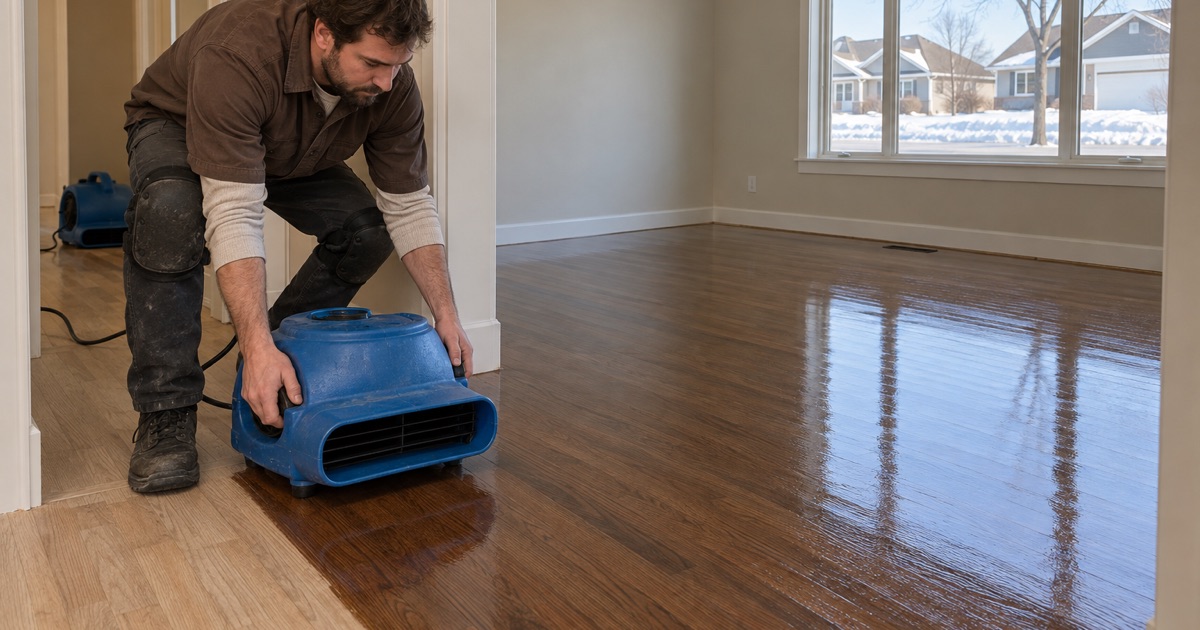
The city’s rental licensing requirement covers all non-owner-occupied rental properties, and it runs on two clocks at once. A license is valid for thirty-six months unless it is revoked earlier, and it renews annually inside that term. Separately, every rental unit in the city is inspected every three years.
The useful part, for a floor, is that neither clock is a surprise. An owner who knows the renewal month and the inspection year is planning in months rather than days.
What the standards name, and what they do not
The city’s rental standards name proper heating, functioning appliances, lighting and smoke detectors. Floors are not among them, and we would rather say so plainly than let an owner spend money believing an inspector is scoring the hardwood. Minnesota Statutes 504B.161 sets a landlord’s general obligation to keep a rented dwelling fit for its intended use and in reasonable repair, which is a broad duty and not a floor-specific line.
So the reason to refinish a rented floor in Shakopee is the asset and the tenant, not a checkbox. A tired but sound floor may need nothing more than a screen-and-recoat between tenants, while a floor showing bare wood at the entry is a different job with a different schedule.
Booking against a date you already know
Because the renewal and the inspection year are both known, we quote a start date and a finished date together. Acclimation for the flooring, the sanding sequence, the coating schedule and the cure window are all laid out before anything is ordered rather than discovered partway through.
Winter is where the planning earns its keep, and we raise the conflict before the work is booked rather than after the gaps appear. On a deep cold snap the relative humidity a house here can safely hold sits below the bottom of the floor’s own specification, because pushing indoor moisture higher in that kind of cold puts water on the windows and inside the walls. A floor installed or finished in that stretch will move when the house comes back up in spring, and an owner deserves to hear it while the timing is still a choice.
None of that rules out winter work. It means board width, species and schedule get chosen with the season in front of us, and the seasonal movement to expect at that width is stated in writing before an order goes in.
Looking for wood-flooring closer to Richfield? See Wood-Flooring Services in Richfield.
Who the three-year cycle actually reaches
It is easy to picture rental inspection as an apartment-building exercise. The housing numbers in Shakopee do not support that picture.
Owner occupancy runs high here: 74.8 percent of occupied housing units are owner-occupied. Of the renter-occupied households, 53.7 percent live in buildings of ten or more units, which leaves a large minority of renters somewhere else entirely. Attached structures, meaning townhome, twinhome and rowhome forms, account for 22.0 percent of all housing units in the city.
Rented houses and townhomes, not only apartment blocks
A licensing requirement that covers all non-owner-occupied rental property reaches the rented house on an ordinary residential street exactly as it reaches the corridor building. The rented house is the one likely to have hardwood running through the main level, and its owner is making a floor decision on a three-year rhythm whether or not anyone tells them to.
Townhomes sit in the same position. A share of them is rented, they carry hardwood or engineered floors through the main level, and they add an association’s rules on top of the owner’s own decision, which is one more thing we ask about before quoting rather than after.
A young housing stock with older rentals inside it
Shakopee’s stock is young by metro standards. Of 17,216 housing units, 47.3 percent were built in 2000 or later, and the 2000s alone account for 30.7 percent, the largest single decade. Floors in that half of the stock usually sit over wood subfloors and are more often candidates for a recoat than for a rescue.
The newer end is still growing. Canterbury Commons, the redevelopment at Canterbury Park, is expected to attract more than $400 million in private investment, and its first phase is a $100 million multifamily residential complex called Triple Crown, the single largest redevelopment project in the city’s history. That is the ten-or-more-units side of the rental market, and it is not the side that usually calls a flooring contractor.
The older end is smaller and it is where the work gets careful. Some 21.9 percent of the city’s units predate 1980 and 8.4 percent predate 1960, which puts a real number of rented houses on the older side of the 1978 line in the federal Renovation, Repair and Painting Rule. Minnesota is not an EPA-authorized state for that rule, so it is administered federally here, and sanding a pre-1978 floor is exactly the disturbance it was written about.
What a rented house shows that a rented unit does not
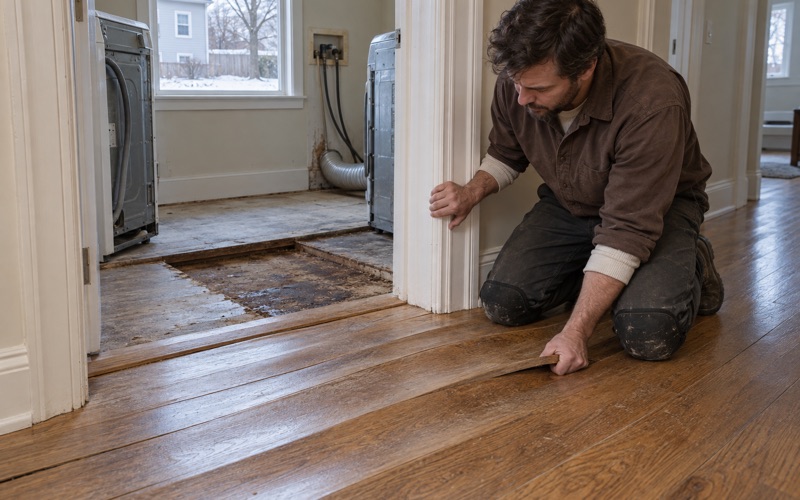
Turn work in a rented house produces a fairly predictable list. Traffic lanes wear the finish through first at the entry and along the kitchen run, furniture drag leaves scratches that stop in the finish rather than the wood, and pets leave their own pattern at the doors. Underneath the cosmetic layer sit the structural items: a squeak over a loose fastener, overwood at a seam where boards have moved, telegraphing where the subfloor has a story of its own.
Gaps in February, tight boards in August
A Minnesota heating season works like a dehumidifier that runs for months. Wood in a house here gives up moisture all winter and takes it back through the summer, and the floor answers with seasonal gapping in February and tight, occasionally cupped boards in a humid August.
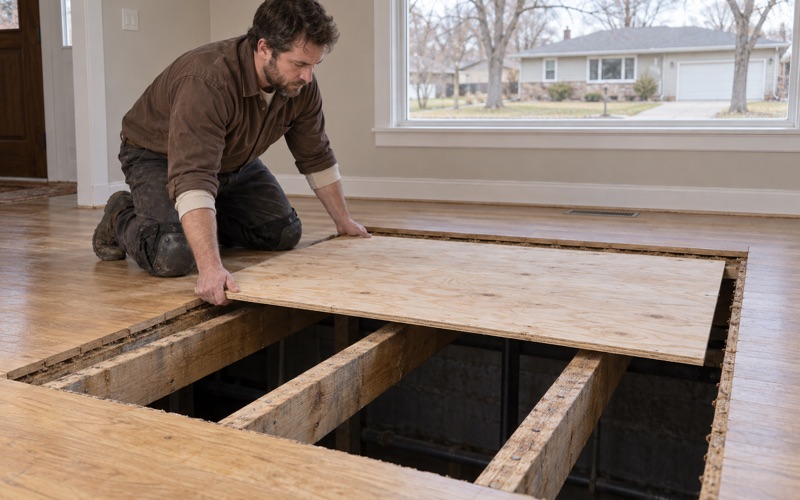
We measure instead of guessing. A hygrometer reading goes on the quote, and a moisture meter reads the flooring and the subfloor separately. Both numbers are recorded before the first board goes down, because the difference between them is what predicts how the floor behaves once it settles to its equilibrium moisture content in that particular house.
Board width belongs to the same conversation. Every species carries its own dimensional change coefficient, and a wide plank in white oak moves more across its face than narrower solid strip flooring in the same room. We choose the width against that number and put the seasonal movement to expect in writing before anything is ordered.
Lower levels, slabs and grade
Scott County’s own guidance notes that most Minnesota homes are built with basements, and that roughly one in three Minnesota homes has radon levels above 4 picocuries per liter. A basement finished as rentable living space is a below-grade installation, and we quote it from a moisture reading taken on that lower-level slab itself rather than inferred from the floor above it.
Grade gets established the way the installation guidelines define it rather than the way a listing describes it. Soil sitting within three inches of a floor puts that level below grade, so a walkout or a lookout is quoted as what it actually is. An in-situ relative humidity test to ASTM F2170 is the honest way to read a slab, and the time it takes belongs in the schedule rather than in a surprise.
Sanding, coating and cure inside a turn window
A turn between tenants is the tightest schedule in residential flooring. The vacancy is a fixed number of days, the floor work has to fit inside it, and the one element that cannot be compressed is cure time.
Recoat or full sand, answered on the floor
A screen-and-recoat is the short path: an abrasive screen cuts the existing finish, a coat goes back over it, and the floor returns to service quickly. It only works while the finish is continuous, because bare wood anywhere on the floor disqualifies a recoat and will read as a witness line through the new coat.
We answer that question with a test patch on the actual floor rather than from the doorway, and we show the owner where it fails when it fails. When a full sand is the answer, the quote carries a written grit sequence and finish schedule, so the number of cuts and the number of coats are a commitment instead of a conversation later.
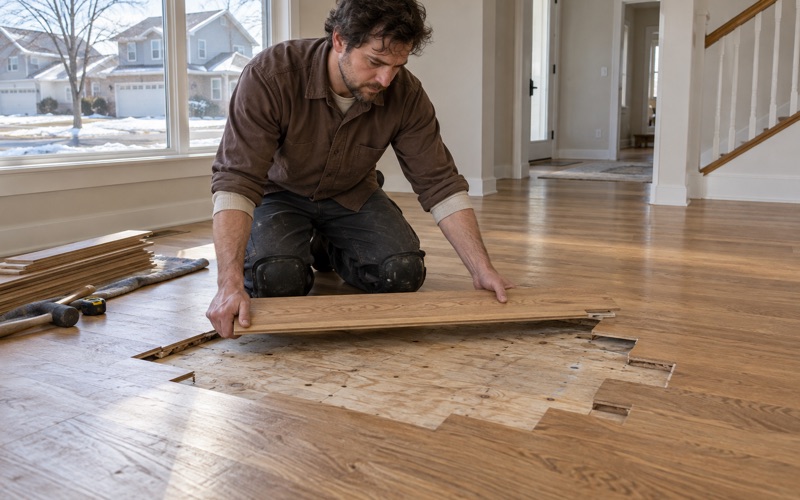
Damaged boards in a rental seldom justify replacing a whole floor. A dutchman patch laced into the existing field and sanded flat with everything around it disappears in a way a spot repair on a finished floor never does.
Cure time is what sets the move-in date
Finish choice sets the calendar more than anything else in the job. A waterborne polyurethane is walkable soon after the last coat and reaches full cure over the following days, while an oil-modified polyurethane takes longer at both ends and carries more odor while it does. We give return-to-service times in writing: when a tenant can walk on it in socks, when rugs can go back down, when furniture can be moved rather than carried.
A January turn adds a wrinkle, because the house cannot open its windows. Dust containment runs through a HEPA vacuum and sealed openings instead of a propped door, and ventilation and cure get planned around a closed house so the finish date is real rather than optimistic.
What the schedule is not waiting on
Finish work is exempt from a building permit under Minnesota Rules 1300.0120, subpart 4, item A, sub-item 8, so a sand-and-finish job is not sitting in a permit queue. The exemption does not authorize work that violates the code or any other ordinance, and construction in this city is governed by the Minnesota State Building Code as adopted and administered by the City of Shakopee.
One jurisdictional point is worth naming plainly. The Shakopee Mdewakanton Sioux Community is a federally recognized sovereign tribe with land inside parts of this city, and we do not assume which authority governs work on that land; we ask before we quote.
The pattern across all of it is the same: a rented floor in Shakopee is a scheduled decision rather than an emergency one. A thirty-six-month license term and a three-year inspection cycle give an owner more notice than almost any other decision on the property, and we would rather spend it measuring, planning and curing properly than working fast in a week with no room in it.
- 20+ Years in the Trade
- Free Written Estimates
- Moisture Readings on Every Quote