Lakeville Wood Flooring handles wood flooring in Northfield with twenty-plus years behind the work, and most of what we are asked to look at here was nailed down long before anyone reading this owned it. A first visit is a measurement visit rather than a sales call: we take a relative humidity reading in the house that day and write it on the quote, with the 30 to 50 percent band wood flooring is specified for printed next to it. That one number decides more about an old floor than the species on top of it.
The job that comes up most often in this city is not a new floor in a new house. It is a floor that has already been sanded two or three times, in a house that has carried tenants for decades, and the question is whether there is enough wood left to do it again. We answer that on the floor rather than from the doorway.
So the quote reads as a set of measurements: moisture content of the flooring and of the subfloor, checked against each other and both recorded; wear layer measured before an engineered floor is quoted for sanding; a written grit sequence and finish schedule, so the number of cuts and the number of coats are a commitment instead of a conversation. Nothing on that sheet asks you to take our word for a number you did not watch being taken.
Old houses divided into units rather than cleared away
Northfield did not replace its oldest housing so much as subdivide it. Of the city’s 6,771 housing units, 1,038 — 15.3 percent — were built in 1939 or earlier, and a substantial part of that layer now holds more than one household. The two-unit structure is the clearest case: the city counts 205 of them, and 184 are renter-occupied, 89.8 percent.
That shape carries through the rental side of the market as a whole. 853 renter households — 43.6 percent of every renter household in the city — are in structures of fewer than ten units rather than in large buildings. Those are houses: up and down, front and back, with a stair that was once interior circulation and now separates two tenancies.
The floor under a conversion
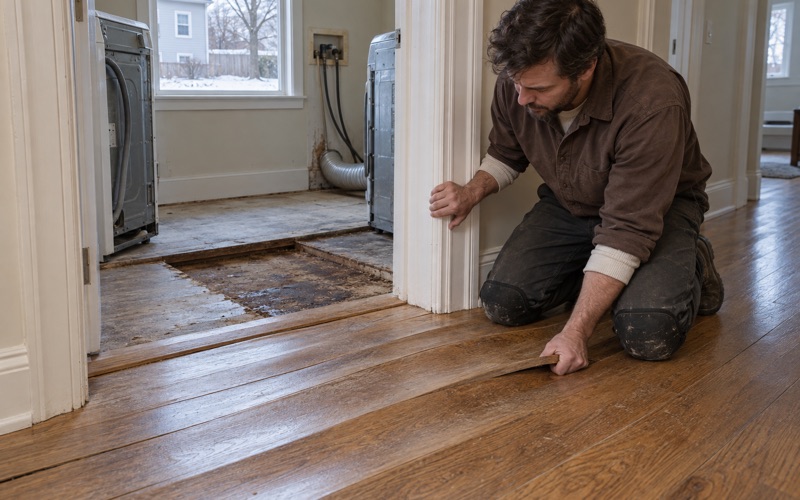
When a single-family house becomes two units, the floor almost never gets replaced along with the walls. It gets a partition set on top of it, a stair enclosed, a doorway closed off and finish patched into the gap, and that work is still readable under the rugs thirty or fifty years later. We open those seams before quoting, because lacing across an old partition line is a different job from a straight sand.
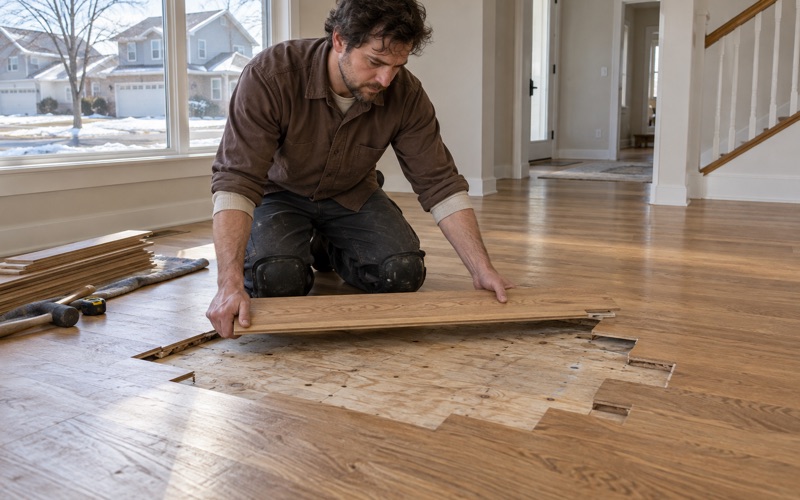
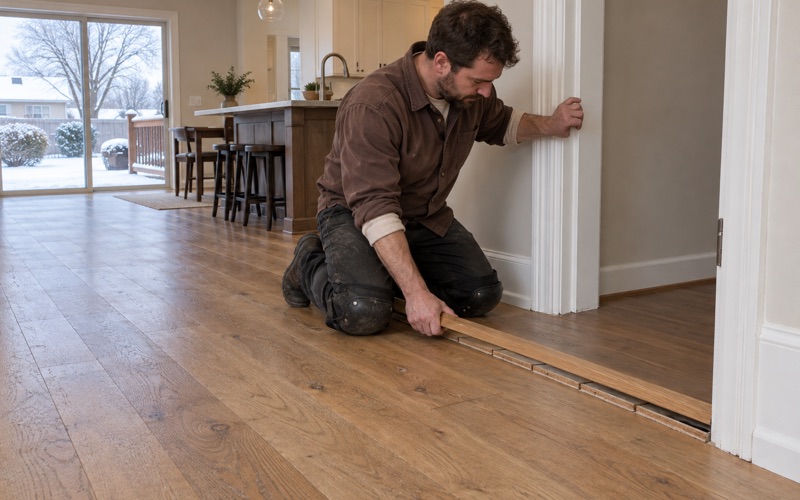
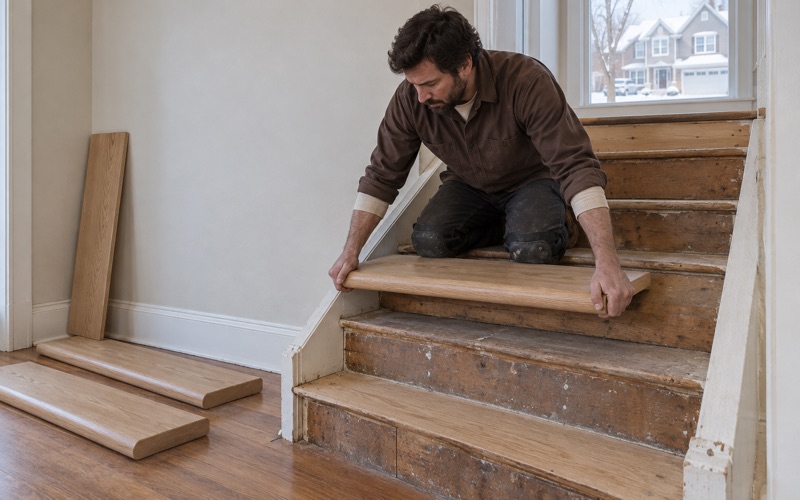
Original solid strip flooring in this stock is usually red oak or hard maple, laid tight and blind nailed, sometimes over rosin paper or asphalt-saturated felt. Where a wall came out, the gap is often filled with boards of a different width or running in a different direction, and weaving new material into old means matching the wear as well as the species. A dutchman patch at a stair nosing is frequently the honest repair where board replacement would mean lifting a run that is otherwise sound.
Looking for wood-flooring closer to Edina? See Wood-Flooring in Edina.
What decades of tenancy leave in a floor
A rented floor wears differently from an owner-occupied one, and it wears in lanes that never move. The run from the entry door to the kitchen and the top three treads of a stair carry nearly all of it, while the perimeter under furniture can still hold finish that is close to original. That unevenness is what we measure first, because it decides between a screen-and-recoat and a full sand.
Recoat or full sand
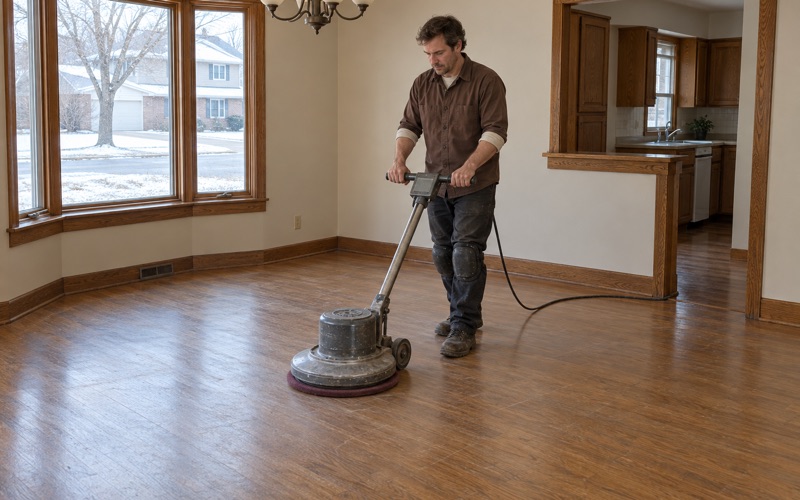
We settle that on the floor with a test patch rather than in the driveway. Bare wood anywhere disqualifies a recoat: a coat laid over a worn-through lane will not bond there, and adhesion failure shows up as peeling in exactly the strip that gets walked on. We cut the patch where we expect the worst of it, and you are shown what came up.
The sands that came before ours
Floors in this stock have usually been sanded more than once, and the earlier passes are readable. Drum marks and chatter marks across the boards, edger swirl ringing the room, picture framing where the edger cut deeper than the drum, and sand-through at a register or a doorway all say how much thickness is already gone. Where a previous crew left overwood at a threshold or a repair, that has to come down before any coating goes on, and on a floor that is already thin it can be the thing that ends the conversation about sanding at all.
Movement is the other half of the record. Cupping across the width of the boards, crowning where a cupped floor was flattened before it had dried, and seasonal gapping in winter are all moisture history rather than damage in themselves. Compression set — boards crushed against one another while swollen, so they gap permanently once they shrink back — is the version that does not reverse, and it turns up in houses that spent summers closed up.
We raise the winter conflict before the work is booked rather than after the gaps appear. In a deep cold snap the relative humidity a house can safely hold sits below the bottom of the floor’s own specification, and a solid strip floor will move under those conditions whoever installed it. Board width is chosen against the species’ own dimensional change coefficient for that reason, with the seasonal movement to expect at that width stated in writing before anything is ordered.
Working inside a licensed rental, on the city’s clock
Northfield’s rental housing ordinance requires a rental license before a residential rental property is occupied, verified by an inspection the owner schedules with the Building Inspection Department at City Hall, 801 Washington Street. The property standards behind that license name flooring and stairs in good repair and constructed to code, in the same list as walls and ceilings finished and in a satisfactory state of repair. A worn tread or a lifting board is therefore not only a tenant complaint; it is a line the inspection reads.
License terms run two years for Type 1, one year for Type 2 and six months for Type 3, so the date a floor has to be finished by is often set by the license rather than by the owner’s preference. We quote against that date. Return-to-service times are written into the finish schedule, because the difference between a waterborne polyurethane and an oil-modified one is measured in days a unit cannot be walked on.
The ordinance also requires the owner or a designated agent to provide access to all areas of the property for that inspection, and the same access question governs how we sequence our own work in an occupied duplex. We plan around which unit can be emptied and when, instead of assuming a whole house is available. A stair shared between two tenancies usually has to be done in halves, and that is decided before the quote rather than during the work.
Permits, dust and cure
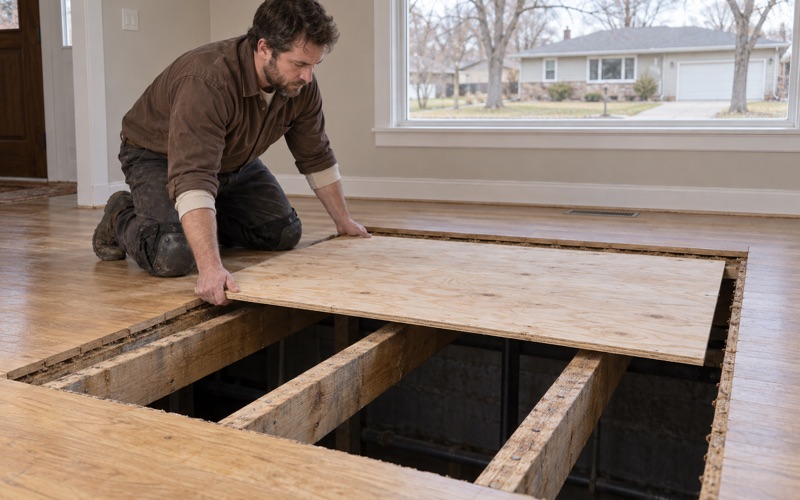
Sanding and finishing an existing floor is finish work. Minnesota Rules 1300.0120, subpart 4, item A, sub-item (8) exempts painting, papering, tiling, carpeting, cabinets, countertops and similar finish work from the building permit requirement, and that exemption does not authorize work in violation of the code or any other ordinance. Structural repair beneath a floor is a different question, and we say which side of the line a job sits on when we quote it.
Containment and ventilation are planned for a house that cannot open its windows for half the year, with dustless containment and HEPA vacuum collection and cure times given in writing. A finish that is walkable is not a finish that is ready for rugs and furniture, and in an occupied building that gap matters to the household upstairs as much as to the unit being worked on.
Disturbing painted surfaces in a house built before 1978 brings the federal Renovation, Repair and Painting Rule at 40 CFR Part 745, Subpart E into the job, administered in Minnesota by the EPA directly rather than through a state-authorized program. On a prewar stair with painted risers and skirts, that shapes how the work is contained and sequenced, and it belongs in writing before anyone starts cutting.
A sale restarts the license, not an inspection history
A rental changing hands in Northfield restarts its license. The new owner has to apply for a new rental license within 30 days of closing, and if no new license has been issued within 60 days of closing the property must stop being rented until one is. That is a rental-licensing provision triggered by a sale, and the distinction is worth keeping straight: the city runs no municipal evaluation that a house has to clear before it changes hands.
For a buyer, the practical effect is a short window with a known end date. Floor work an inspection will look at is better scheduled against that 60-day edge than discovered at day 45, and a full sand with a multi-coat schedule needs the calendar. We will say plainly when a recoat gets a unit back in service inside that window and a full sand does not.
What an old floor is worth spending on
Not every old floor should be sanded again, and we would rather say so at the quote than halfway through one. Where the wear layer on an engineered floor measures under the sanding threshold, the honest answer is replacement rather than a refinish, and we measure it before quoting a sand rather than after opening one up. On solid strip flooring that has already been through several passes the calculation is the same in a different form: how much wood remains above the tongue.
For an owner renting the unit out, the useful question is what the floor has to survive before the next turnover, not how it would photograph. A screen-and-recoat on a floor that still carries film everywhere buys years for a fraction of the cost of a sand, and it can be repeated. A full sand earns its place when there is enough thickness left to repeat it once more after this one, and not when there is not.
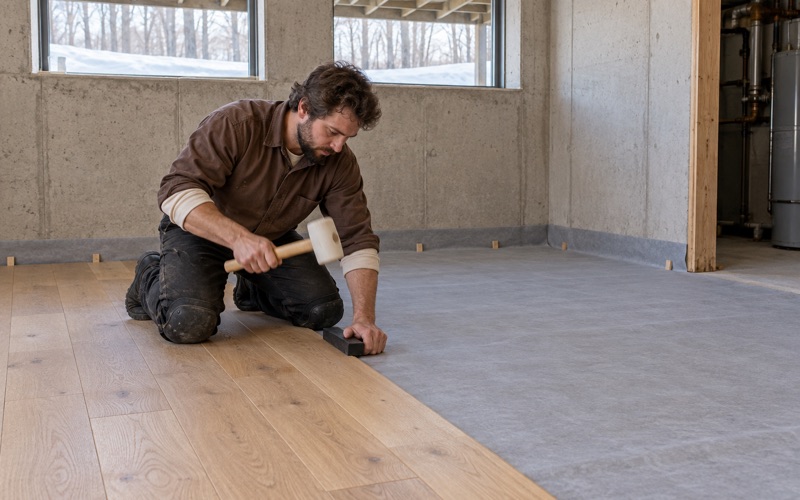
Lower-level work is quoted from a moisture reading taken on the lower-level slab itself, never inferred from the floor above it. Grade is established the way the installation guidelines define it, so soil sitting within three inches of a floor puts that level below grade and a walkout or a lookout is quoted as what it is. In a converted house with a rented lower unit that distinction usually decides between engineered flooring and solid, and we would rather have the conversation before material is ordered.
Whatever the floor needs, the numbers behind the quote stay on the sheet you keep: the humidity reading from the first visit, the moisture content of the flooring and the subfloor, the grit sequence, the coats and the cure times. If the job changes, it changes against a recorded starting point rather than against a memory.
- 20+ Years in the Trade
- Free Written Estimates
- Moisture Readings on Every Quote