
Lakeville Wood Flooring has handled hardwood floor repair across Lakeville, MN for more than 20 years, serving surrounding cities including Farmington, Apple Valley, Burnsville, Savage and Elko New Market. Board replacement, weave-ins, dutchman patches, squeak and fastener work, subfloor repair under a failing floor and the full range of moisture damage all sit inside that work. What they have in common is that none of them should be quoted before the cause is understood.
A repair that treats the symptom is a repair you pay for twice. Cupped boards replaced while the moisture source is still active will cup again; a squeak screwed down without finding the loose subfloor panel moves to the next board over. Our first visit is a measurement visit, with a moisture meter and a hygrometer rather than a price sheet, and the readings go on the quote.
We also tell you when a repair is not the answer. On an engineered floor we measure the wear layer before quoting anything that involves sanding, because under the sanding threshold the honest recommendation is replacement rather than a refinish that will cut through to the core. That is a cheaper conversation to have at the quote than with a drum sander already running.
The Repairs a Wood Floor Actually Needs
Board Replacement and Weave-Ins
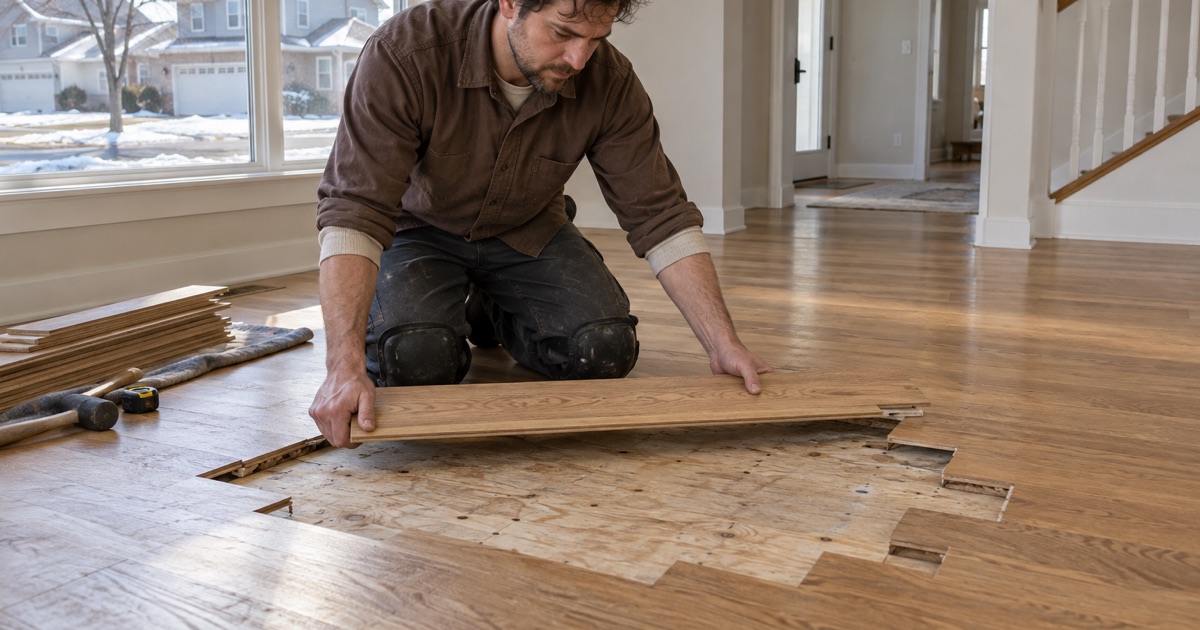
Damaged boards are cut out individually and new material is woven in with staggered end joints, so the repaired area reads as part of the floor rather than as a rectangle set into it. Lacing the joints out into the surrounding field is what makes the difference, and it is the step a fast repair skips. We match species, cut and width before anything is ordered, then sand and coat the area into the floor around it so the sheen carries through.
Dutchman Patches for Localized Damage
Where the damage is smaller than a board — a burn, a gouge, an old pipe penetration — a dutchman patch removes just the failed section and fits a new piece with the grain running the same direction. It is slower per square inch than replacing the whole board and it disturbs far less of the floor around it. On a rare or discontinued floor, that conservation of original material is often what makes a repair possible at all.
Squeaks, Ticking and Loose Fasteners
A squeak is movement, and the repair depends on where the movement is. Subfloor lifting off a joist is fixed from below where there is access, with nothing visible on the finished side; a board that has shrunk away from its flooring cleat is a different problem with a different fix. Ticking that shows up in January and disappears by June is seasonal shrinkage rather than a defect, and we will tell you that instead of selling a repair for it.
Moisture Damage: Cupping, Crowning and Buckling
Cupping and the Moisture Source Underneath
Cupping is board edges standing higher than their centers, and it means the underside of the floor is wetter than the top. The repair is therefore not a sanding but an investigation: a crawl space, a slab, a slow supply line, a dishwasher that has been weeping for a year. We take readings across the field to map where the moisture is worst, which usually points at the source, and the floor is not touched with a machine until the numbers come back down.
Crowning After a Floor Was Sanded Too Early
Crowning is the opposite profile, centers higher than edges, and it is very often a cupped floor that somebody sanded flat before it had dried. Once the wood finishes releasing that moisture it shrinks back and the sanded-flat surface becomes convex. There is no quick correction: the floor has to reach equilibrium and then be sanded again, and there has to be enough thickness left to allow it. We check that there is before quoting.
Buckling and Compression Set
Buckling is a floor that has lifted clear of the subfloor, and it means the boards ran out of room to expand — either a serious wetting event or an installation with no expansion allowance at the walls. Prolonged pressure also produces compression set, where the board fibers are permanently crushed and gaps stay open even after the floor dries back. Those boards do not recover and they come out; we identify which ones rather than replacing the whole field by default.
Matching a Floor Nobody Makes Anymore
Species, Cut and Width
Matching starts with identifying what is actually down: red oak against white oak, plainsawn against rift sawn or quartersawn, and the exact face width, which on older floors is frequently not a size still sold. Hard maple, hickory and beech each bring their own grain and their own stain behavior into the decision. We establish all of it before sourcing, because a board that is right in species and wrong in cut will never disappear into the floor.
Blending With Penetrating Stain
New wood set into an aged floor starts lighter, since the existing boards have ambered under years of finish and light. Once the repair area is sanded, a penetrating stain brings the new material toward the old, and the sample goes on your own boards rather than on a chip. Water popping is used where the new wood needs to take stain more deeply to catch up with its neighbors.
When a Transition Beats a Match
Sometimes the honest answer is that no acceptable match exists, and forcing one produces a repair that draws the eye forever. A deliberate transition at a doorway, with a threshold that reads as a design decision, is a better outcome than a patch nobody can stop looking at. We say which of the two your floor allows at the quote, and we would rather lose the bigger job than hand back a repair you will regret.
Repairs That Are Really Subfloor Problems
Hollow Spots and Telegraphing
A floor that sounds hollow underfoot or shows the outline of the subfloor panels through the finish is reporting a problem below itself. Telegraphing usually means panel edges have swollen or the fastener spacing schedule was never adequate; hollow spots on a glue-down mean the adhesive never fully transferred. Both are fixed from the subfloor up, and repairing only the surface leaves the cause in place.
Overwood at the Joints
Overwood is one board sitting proud of its neighbor, and on a repair it is the difference between a finished floor and an obvious seam. It comes from an uneven subfloor, from mixed board thicknesses, or from a nailer that was not seating boards fully. We flatten the substrate before new material goes down rather than trying to sand the height difference out afterward, which only thins the boards around it.
Insect Damage and Rot
Small round exit holes with fine frass beneath them are the signature of a powderpost or lyctid beetle working in hardwood, and the affected material has to come out rather than be filled. Rot in a subfloor under a long-term leak is the same judgment on a larger scale. We open enough of the floor to find the boundary of the damage, because a repair that stops short of sound material is a repair that gets redone.
Our Step-by-Step Hardwood Floor Repair Process
Measure Before Anything Is Quoted
The first visit records relative humidity in the house, moisture content in the flooring and the subfloor, and wear layer thickness where an engineered floor is involved. Those numbers go on the quote with the 30 to 50 percent band wood flooring is specified for printed beside them, so you can see what the floor is living in rather than take our word for it.
Find and Stop the Cause
Where the damage is moisture related, nothing is replaced until the source is found and dealt with and the floor has come back to a stable reading. That step is not optional and it is where most repeat repairs come from. We re-measure rather than working to a calendar, and we tell you plainly when a floor needs more drying time than anyone wants it to.
Replace, Weave and Blend
Boards come out, new material goes in with staggered joints and correct fastening, and the area is sanded into the surrounding floor. Stain samples are approved on your boards before the floor is committed to a color. This is the stage where matching either works or does not, so it is the stage we spend the time on.
Coat, Cure and Hand Back in Writing
The finish schedule names how many coats the repair is getting and which finish system is going on. Dustless containment with a HEPA vacuum keeps the sanding contained in a house that cannot open its windows for much of the year, and the return-to-service times — when you can walk on it, when rugs and furniture can come back — are handed over in writing rather than estimated on the last day.
- 20+ Years in the Trade
- Free Written Estimates
- Moisture Readings on Every Quote