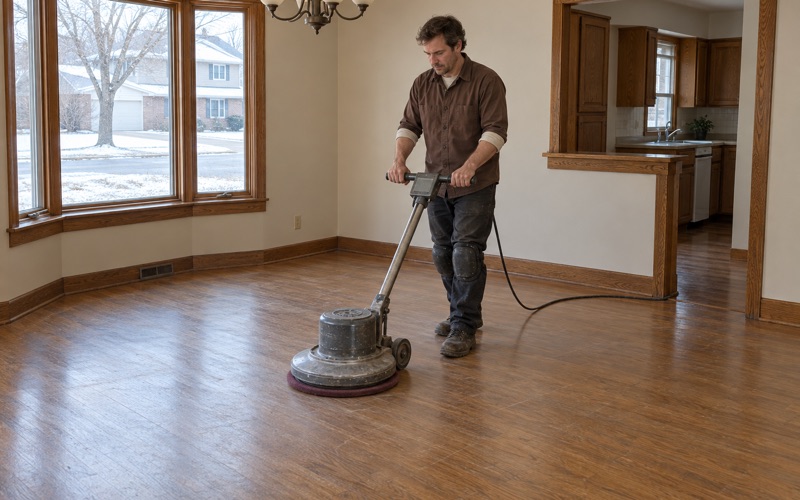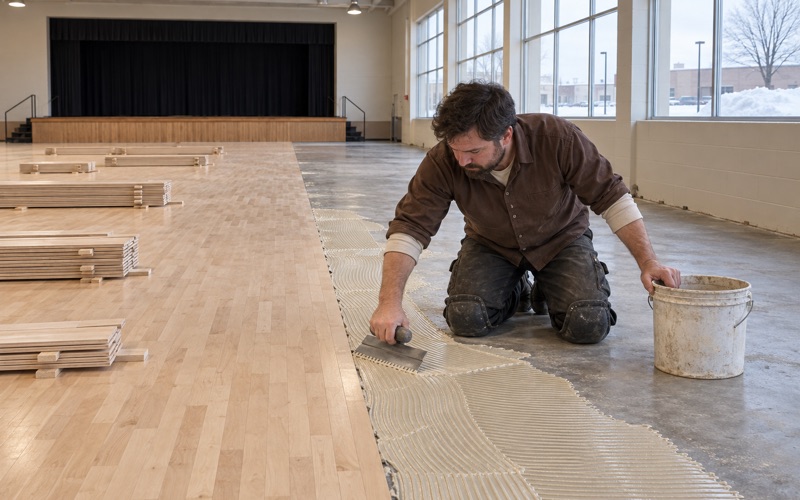
Lakeville Wood Flooring installs, sands and refinishes wood flooring in Burnsville, and after more than twenty years in the trade we start every job here with a question that sounds like it belongs to a different industry: is anyone going to score this floor? For a large share of the housing in this city the answer is yes, because the City of Burnsville does not issue a rental license and inspect afterward. The inspection comes first, and the license follows it.
That order rearranges how a floor job gets planned. An owner calling us about a worn oak floor in a rental house is not only buying a finish; they are buying a line item that somebody with a clipboard will look at, on a date that has already been set by someone else. We work backward from that appointment, so the days the floor is off limits are settled before anything is booked rather than discovered afterward.
The first visit is a measurement visit rather than a sales call. We take a relative humidity reading in the building and write it on the quote next to the 30 to 50 percent band wood flooring is specified for, we put a meter on the boards and a meter on the subfloor, and we record both numbers rather than one. What we quote after that is what the floor needs, which is sometimes less than the owner was bracing for and occasionally more.
The license comes after the inspection, not before it
The City of Burnsville requires a license to rent property, states that licenses are only issued after an initial inspection of the property has taken place, and renews that license annually. It is not a multifamily-only program. Single-family rentals are covered the same way a building of apartments is, so a house on a quiet street with one family in it is walked against the same scored checklist as a corridor of units.
Renting is a real part of the housing stock here. Of 25,891 occupied housing units, 9,151 are renter-occupied, and 64.7 percent of occupied units, 16,740 of them, are owner-occupied. Most of what is owner-occupied is a house rather than an apartment: 11,158 units are one-unit detached structures, 66.7 percent of the owner-occupied total, and another 3,855 are one-unit attached. What sits under a licensed rental in this city is therefore the same flooring we work on everywhere else in Dakota County, which is to say strip oak over a joist bay, engineered plank over a lower-level slab, and stair treads hiding under carpet.
Behind the city’s form sits Minn. Stat. 504B.161, the statute that puts a repair covenant on a landlord and requires the premises be fit for their intended use and kept in reasonable repair. The checklist is how that obligation gets scored on a given morning, and the floor is one of the things on it.
Working to a date you did not choose
A move-in date can slide by a weekend. An inspection appointment generally cannot, and a waterborne finish does not care which one you are trying to make. A floor that is walkable is not a floor that is cured, and furniture and area rugs go back on a schedule of their own. We hand that schedule over in writing, along with the ventilation plan for a unit whose windows may be shut for the season, so the owner knows on day one whether the calendar they have in mind is real.
Looking for wood-flooring closer to Savage? See Wood-Flooring in Savage.
What the Floors section actually says
The Floors section of the city’s rental inspection checklist is short enough to quote outright. It reads “Floors free of holes, cracks and tripping hazards” and “Water-tight surfaces in bathrooms and kitchens.” Two scored lines, and both of them are answerable without a new floor far more often than owners expect.
Holes, cracks and tripping hazards, in flooring terms
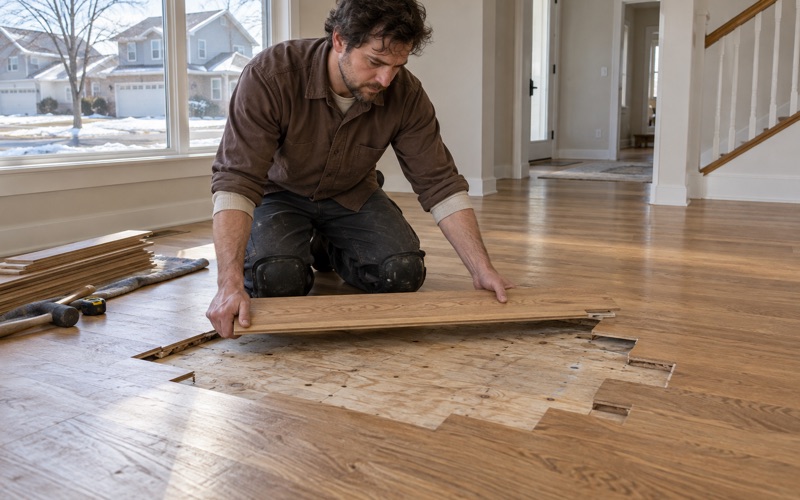
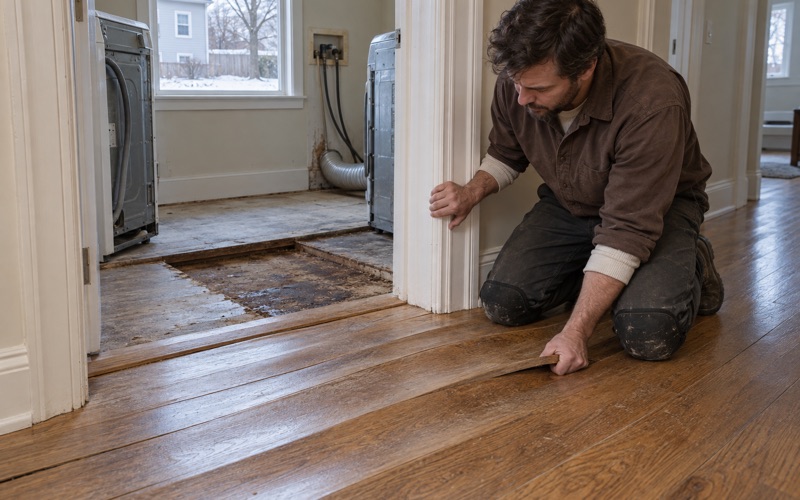
A hole in a wood floor is usually a split board, a knot that has finally let go, or the rectangle left where a floor vent or an old threshold was moved and never filled. Board replacement takes the damaged piece out and sets a matching one in its place. A dutchman patch closes a smaller void with a fitted block. Weaving fresh boards into the surrounding field, which we call lacing, leaves a repair that disappears under the next sanding rather than announcing itself.
Cracks are the item read wrong most often. Seasonal gapping between boards in the middle of a cold, dry winter is wood behaving exactly as its species and board width say it will, and those gaps close again when the air comes back. A separation that runs across a board instead of between boards, or a gap that never closes in any season, is a different finding. We say out loud which one we are looking at, and when the cause is humidity rather than the floor we say that too, because replacing boards will not fix the air.
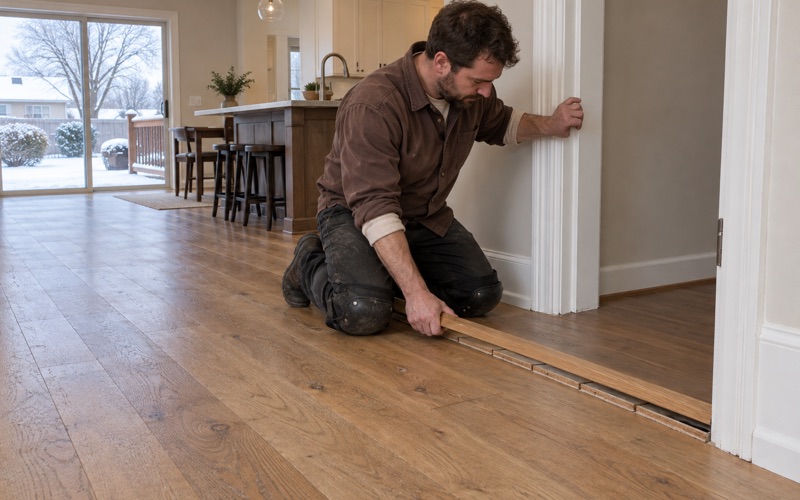
Tripping hazards reward a slow walk before the inspector takes one. Overwood where a plank meets a transition, the raised edge of a cupped board, a loose board that shifts underfoot, a lifted nosing at the head of a stair: every one of those is scored, and every one has a fix well short of tearing out the field.
Water-tight surfaces where the floor meets a wet room
The second line puts kitchens and bathrooms on the same page as the floor, which is where a wood run has to end somewhere deliberate. We decide that edge on purpose rather than letting it land under an appliance, and we seal the end grain at the tub, the toilet flange and the dishwasher bay, because that is where a slow leak gets into a subfloor and turns two boards into eight.
When a unit is coming back from water damage, the place a floor stops is also an insurance question. We put it to the adjuster in writing before any tear-out starts, not after the wet room is already open and everyone is arguing about how far the run reasonably continues.
Stair carpet and handrails, the items most often written up
Under Stairs and Guardrails the same checklist reads “Carpeting on stairs is secure” and “Handrails are present and secure,” and both lines repeat under Multi-Family Interior Common Areas. In a building with shared circulation the stairs are effectively scored twice, once inside the unit and once in the space every tenant uses.
What the carpet has been hiding
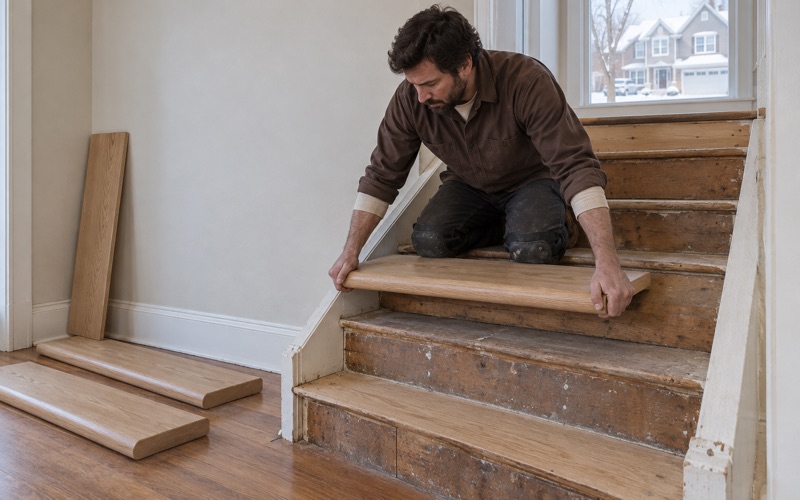
Pull a stair runner in an older rental and the treads underneath are rarely finished. We find paint over the risers, unfinished oak on the treads themselves, a nosing worn round at the leading edge, and a few hundred staples. That is a normal starting point, not a disaster, and it is usually the cheapest square footage in the building to bring back, because stair treads are solid stock and there is very little of it.
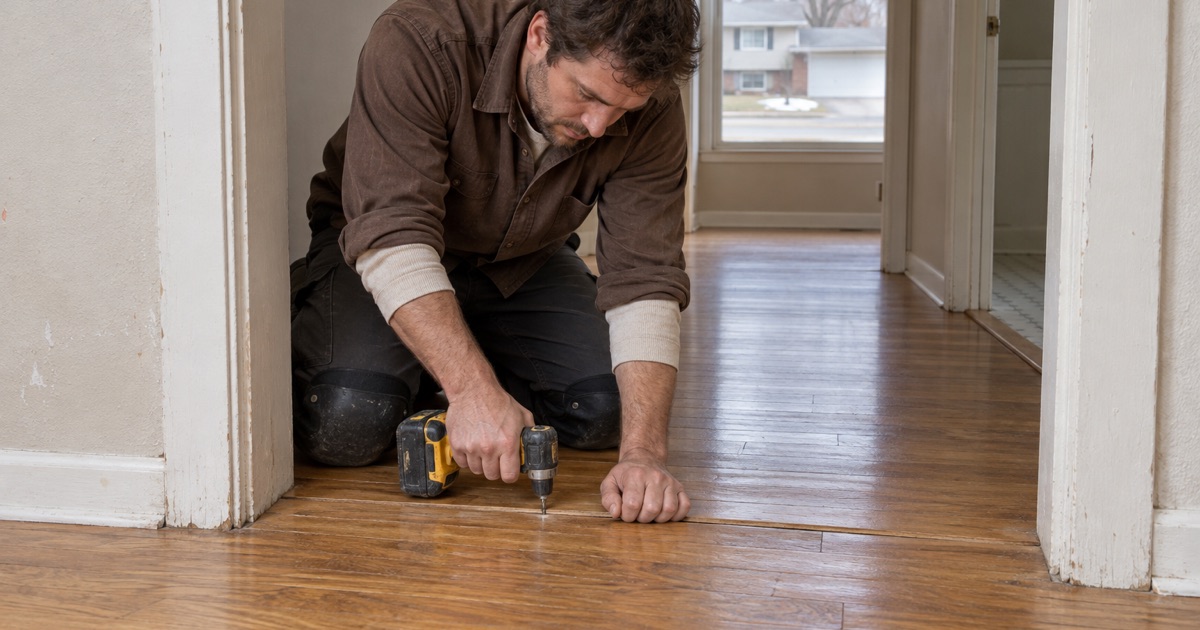
Noise belongs in the same conversation. The squeak, the tick and the pop a stair makes come from a fastener working in a slightly loose joint, and treads that have carried a runner for decades have had those joints hidden rather than solved. Refastening a tread properly, blind nailing where the joint allows it and top nailing with a filled plug where it does not, is what makes a stair quiet and secure in the same pass.
Secure is a word about fasteners
An inspector checking whether carpeting on stairs is secure is checking edges and fasteners, particularly at the nosing where a runner lifts first. A handrail is judged the same way, as a thing that is present and does not move under a hand. Those two line items intersect in exactly one place, which is a refinish: a rail that comes off the wall so the treads can be sanded has to go back into framing that holds it, and a runner that comes up for the same reason may not go back at all if the owner decides finished treads read better to the next tenant.
Either way, a stair under work closes the route between floors for a set number of hours. We state those hours up front, because in an occupied building that is the detail that decides whether the work happens now or waits for a vacancy.
Getting a unit through a re-inspection without replacing the floor
Recoat or full sand, settled on the floor itself
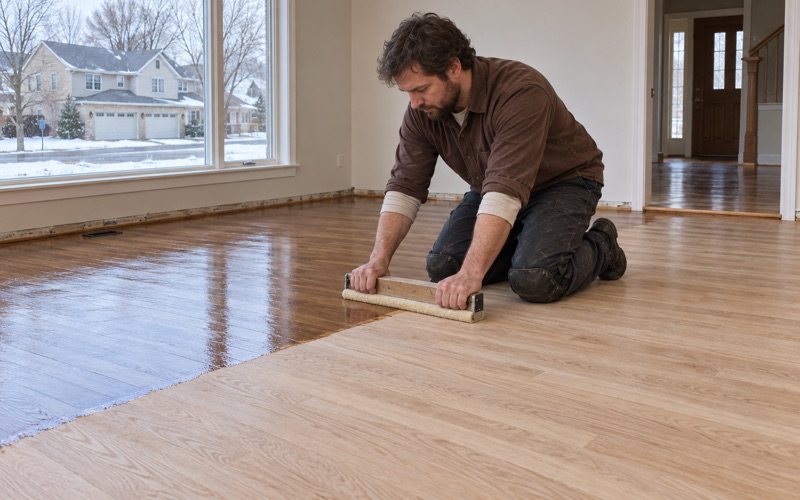
We answer this one with a test patch rather than an opinion. An abrasive screen over a small area shows whether the existing finish will take another coat, and bare wood anywhere in the field disqualifies a buff and coat, because a new coat bonds to the old finish and not to the wood beside it. When that is the finding we show the owner the spot it came from.
When a screen and recoat will genuinely hold, it is the cheaper and faster route through a re-inspection and we say so. In both cases the grit sequence and the finish schedule are written on the quote, so the number of cuts and the number of coats is a commitment rather than a conversation later.
Engineered floors and the wear layer
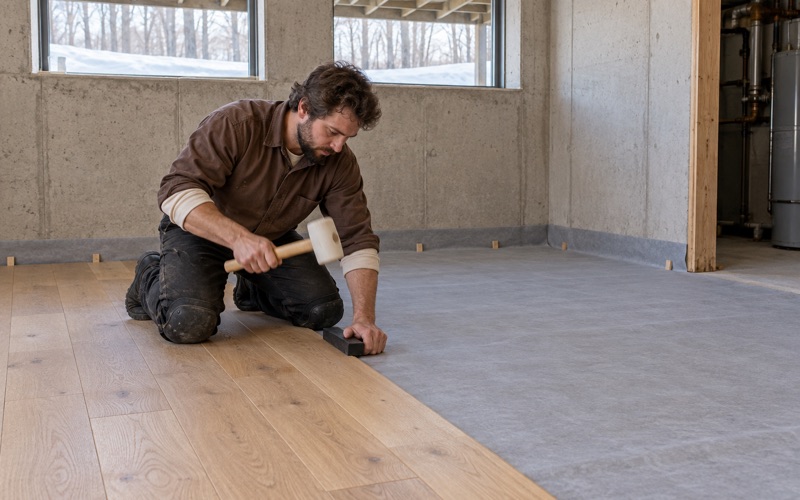
Plenty of lower levels and newer units here are engineered rather than solid, and an engineered floor can only be sanded while the veneer above the tongue still has thickness to give. We measure the wear layer before we quote a sand, not after the drum is running, because under the sanding threshold the honest answer is replacement and a sand-through is not something anyone can put back.
Lower levels, grade and a slab that has to be read directly
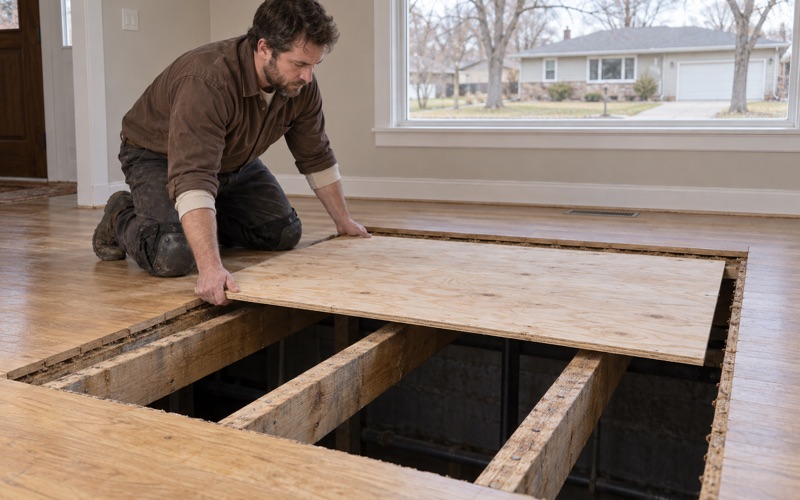
Burnsville sits on a bluff over the south bank of the Minnesota River, roughly fifteen miles south of downtown Minneapolis. Where a lot falls away like that, a lower level can be a walkout on one wall and fully below grade on another. Grade is not a judgment call: the installation guidelines put a floor below grade when soil sits within three inches of it, so we quote a walkout or a lookout as what it actually is. The moisture number for that level comes from a reading taken on the lower-level slab itself, never inferred from the floor above it, because the slab and the framed floor over it are two different environments.
No permit does not mean no inspection
Minnesota Rules 1300.0120, subpart 4, item A, sub-item (8) exempts painting, papering, tiling, carpeting, cabinets, countertops and similar finish work from permit, and the same subpart says an exemption does not authorize work that violates the code or other ordinances.
Refinishing a floor does not send anyone to the counter for a permit, and it also does not take the floor off the checklist the license depends on. Those are two different systems, and clearing one says nothing about the other.
- 20+ Years in the Trade
- Free Written Estimates
- Moisture Readings on Every Quote