Lakeville Wood Flooring installs, sands and refinishes wood flooring in Apple Valley, and after twenty-plus years in the trade a large share of that work lands in attached units the owner does not live in. A townhome floor that turns over with the lease is a different job from a floor in a house someone intends to grow old in, and quoting the two the same way is how a job goes wrong.
An owner in that position is usually deciding at a distance, between tenancies, against a date that is already fixed. What they need from a flooring contractor is not enthusiasm but numbers: how many cuts, how many coats, how long until the unit can be occupied again, and what the floor actually is underneath the finish on it.
So the first visit is a measurement visit. We read moisture content in the boards and in the subfloor and record both numbers against each other before any board goes down, and every number further down this page comes from readings like those rather than from a look around the room.
Attached housing that is rented rather than owned
Apple Valley is not primarily a rental city, and the flooring work here reflects that. Of 21,627 occupied housing units, 15,880 are owner-occupied, 73.4 percent of the total, and 5,747 are rented. What makes the rented side worth its own page is not its size but its shape.
The rented stock here is not mostly apartment corridors. One-unit attached structures, the townhomes and twinhomes that share a wall with the unit next door, account for 27.5 percent of all 22,013 housing units in the city, 6,061 of them. ACS 2024 five-year table B25032 records 1,490 of those one-unit attached units as renter-occupied. That is a specific inventory: individually owned floors, individually leased, each one aging on its own schedule behind a party wall.
The stock is not old, but it is not new either
The area was established in 1859 as Lebanon Township and stayed agricultural for roughly a century. Residential development began in the mid-1950s, and the city incorporated at the 1968 general election, where voters chose Apple Valley over Lebanon Valley by 1,376 to 757. The 2020 census counted 56,374 residents.
The building that followed came in waves that sit unusually close together. The 1990s account for 22.9 percent of housing units, the 1980s 20.7 percent and the 1970s 20.1 percent, three cohorts within three points of one another, with a further 26.4 percent built in 2000 or later.
For flooring that matters more than it sounds. A unit from the 1990s is old enough that an original floor has already had a refinish or two, and new enough that engineered product over a thin wear layer is common in it. Those two facts decide whether a floor gets sanded or replaced, and neither of them can be settled from the doorway.
What a leased floor has usually been through
Rented floors wear differently from owned ones. Traffic concentrates into narrow lanes, furniture pivots in the same two places for years, and the cleaning history is whatever a series of tenants happened to use. The damage tends to be local rather than general: a blown-out threshold, a worn strip in front of a sink, a patch where a chair lived.
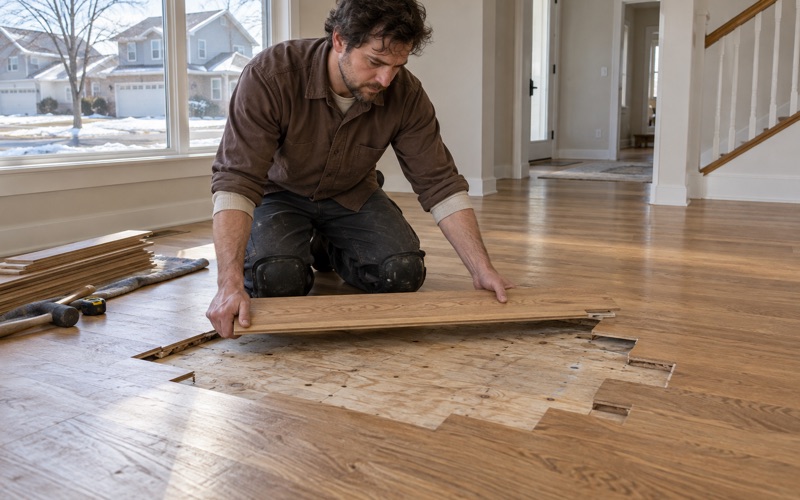
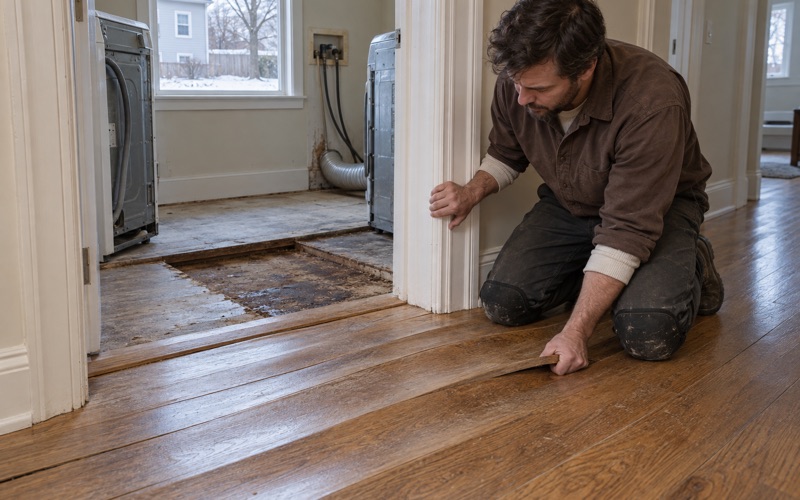
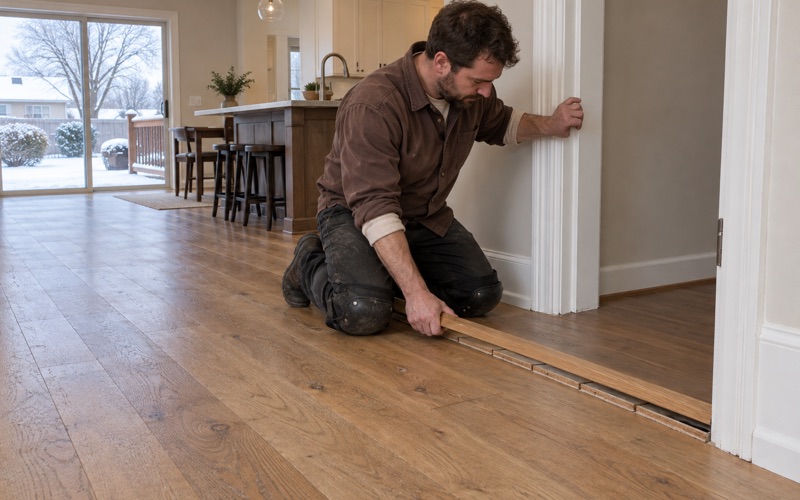
Local damage is better news than a generally tired floor, because it opens repairs a whole-floor problem does not. Board replacement, a dutchman patch, or a weave-in that laces new boards into the existing field can carry a unit through another tenancy without a week of vacancy.
Looking for wood-flooring closer to Burnsville? See Burnsville Wood-Flooring.
Chapter 122: registration, the thirty-day clock, and what it is not
Every residential rental property in Apple Valley must be registered with the city by the owner or the rental manager under City Code Chapter 122. Owner-occupied property is exempt. We bring it up because first-time landlords often assume the requirement is heavier than it is and hold off on work that has nothing to do with it.
Registration is free, and nothing is inspected
Registration costs nothing. It is administered through the police department, and no inspection of the unit comes with it. Nobody from the city walks the floors, signs off on a finish, or holds a unit pending a visit. The registration records who is responsible for a property; it is not a verdict on that property’s condition.
That is worth stating plainly, because it removes an imaginary deadline from a flooring schedule. There is no municipal visit to be ready for and no condition standard the floor has to pass on a given date. Timing is set by the lease, by cure times, and by nothing else.
The thirty-day clock runs on change, not on the calendar
The deadline that does exist is thirty days, and an event triggers it rather than an anniversary. Registration must be renewed within thirty days of a change in ownership, a change in management, a change in the number of units, or a change from owner-occupied to rental.
That last trigger is the one that catches people. An owner who moves out and leases the home they used to live in has thirty days to register it, and that is usually the same month they are deciding what to do about the floors. The two decisions are independent, but they arrive together, and knowing the registration is a free form rather than an inspection often frees up the flooring budget.
Permits do not attach to finish work either
Sanding and refinishing an existing floor is finish work. Minn. R. 1300.0120, subpart 4, item A, sub-item (8) exempts painting, papering, tiling, carpeting, cabinets, countertops and similar finish work from permit, and the same subpart states that an exemption does not authorize work in violation of the code or other ordinances.
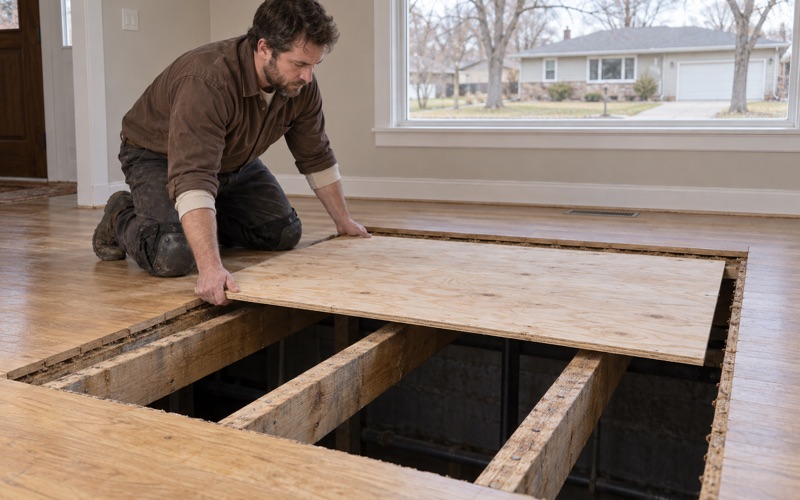
Structural repair uncovered beneath a floor is a different conversation, and we raise it the day we find it rather than the day we invoice. Framing, joist and subfloor repair is not finish work, so the exemption above does not reach it; that work sits with the City of Apple Valley as administrator of the Minnesota State Building Code, and the owner decides how to proceed before we lay anything over it. On a unit with a tenancy date already attached to it, that is also the moment the return-to-service dates have to be reissued, because a schedule built around sanding and coating cannot absorb a repair nobody had priced.
What changes about the work when the occupant is a tenant
The technical work is the same work. The constraints around it are not. A floor between tenancies is scheduled against a lease date, approved by someone who will not be standing in the room, and handed to a person who had no say in any of it.
Return-to-service dates, given in writing
The question an owner needs answered is when the unit is rentable again, not when we stop sanding. So the return-to-service times go in writing: when the last coat goes down, when foot traffic is allowed, when furniture and rugs can come back, and what the full cure time is for the finish being used.
Those numbers are not interchangeable between products. A two-component waterborne finish, an oil-modified polyurethane and a hardwax oil each carry their own schedule, and the lowest quote is sometimes the one that costs an extra week of vacancy. That is an argument worth having before the work is booked.
The grit sequence and the finish schedule are written on the quote for the same reason. Three cuts and two coats is a different floor from two cuts and three coats, and an owner reviewing the job from somewhere else deserves those counts as a commitment rather than as something discussed on site.
Recoat or full sand, settled on the floor itself
Between tenancies the money question is whether a floor can be screened and recoated or needs a full sand. We answer it on the floor with a test patch, because bare wood anywhere disqualifies a recoat. An abrasive screen cannot feather into a spot where the finish is already gone, and a new coat will not bond there.
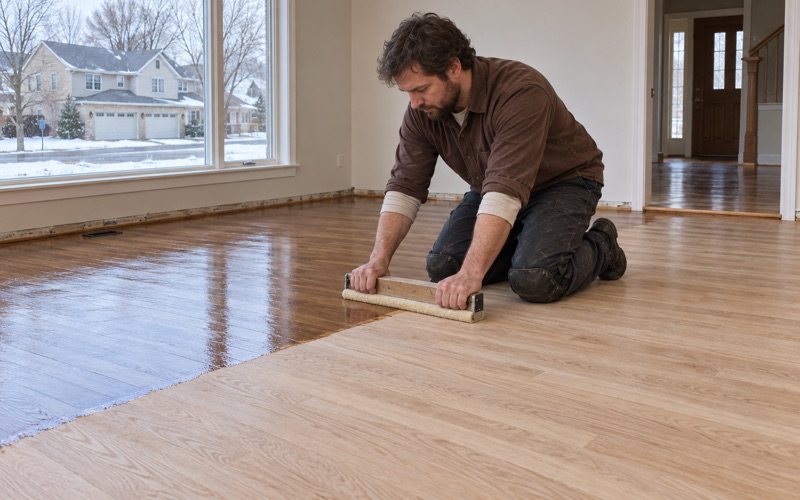
When the patch says the floor is a candidate, a buff and coat can turn a unit around in a fraction of the time a full sand takes. When it says otherwise, we show the owner the square foot that disqualifies it instead of reporting a verdict they have to take on faith.
Engineered floors and the sanding threshold
Attached housing carries a lot of engineered flooring, and engineered flooring cannot be quoted for sanding until the wear layer has been measured. Under the sanding threshold the honest answer is replacement. One aggressive pass of a drum sander through a thin veneer produces sand-through, and sand-through cannot be fixed with finish.
We measure first and quote second. An owner told a floor has three more sandings in it, when it has none, has bought a plan that ends in a full replacement anyway, on a worse schedule and after paying for the sanding twice.
Working in an attached unit with neighbors through the wall
A townhome job happens in somebody else’s building as much as in the owner’s unit. Noise carries through the party wall, the crew needs one predictable point of entry and one parking arrangement, and the lower level sits on a slab that behaves nothing like the framed floor above it.
Sound ratings come from the governing documents, not from state law
Minnesota does not impose an impact-sound or sound-transmission rating that a townhome floor has to meet. What can bind a particular unit is its own association’s governing documents, which under Minn. Stat. 515B are where common interest ownership requirements are set, including underlayment specifications for hard-surface flooring.
We ask what applies before specifying an assembly. If a cork underlayment or a particular layered system is called for beneath the flooring, it belongs on the quote as a line item rather than appearing later as a change order.
Lower levels, grade, and reading the slab
Many attached units here are walkouts or lookouts, which makes grade a measurement rather than a description. Where soil sits within three inches of a floor, the installation guidelines put that level below grade, and we quote a below-grade installation as exactly that instead of pricing it like a main floor.
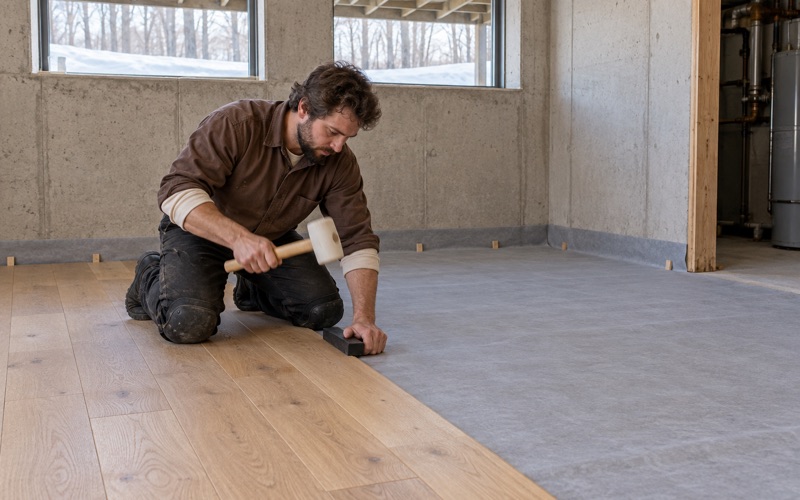
The moisture reading for a lower level is taken on the lower-level slab itself and never inferred from the floor above it. An in-situ relative humidity test to ASTM F2170 reports what the concrete will actually give back to a floor, and that number is the difference between a floor that stays flat and one that cups through its first humid season.
The winter conflict, explained before the work is booked
The air in the unit matters as much as the slab under it. Wood flooring is specified for a 30 to 50 percent relative humidity band, and during a deep cold snap the humidity a Minnesota building can safely hold sits below the bottom of that band with nothing at all wrong with the building.
Seasonal gapping in February and tight boards in August are what that conflict looks like in a finished floor. We take a relative humidity reading on the first visit and write it on the quote beside the band the flooring is specified for, and we choose board width against the species’ own dimensional change coefficient, stating in writing how much seasonal movement to expect at that width before anything is ordered. Twenty-plus years in, that is still how a rented townhome gets quoted here: from readings, against the owner’s date, and with the neighbors’ wall accounted for.
- 20+ Years in the Trade
- Free Written Estimates
- Moisture Readings on Every Quote